Wilderness trails- Wolhuter Trail
Kruger National Park- Activities
| Contact Details | |
|---|---|
| Telephone | +27 12 426 5111 |
| Website | www.sanparks.org |
| reservations@sanparks.org | |
| Physical | Berg en Dal to Malelane Road, Kruger National Park |
Profile
The first of all the wilderness trails is situated roughly between Berg-en-dal, Ship mountain and Afsaal picnic site. It was named after one of the first rangers that were appointed in the establishment of the Sabie Game Reserve in those days – 1902. Harry Wolhuter later in his career killed a lion single handedly with his hunting knife while out on patrol on horseback.
It is a spectacularly scenic wilderness area characterized by high granite outcrops with deep valleys as well as a flatter undulating landscape. Wilderness qualities are high as the trail area is far removed from the boundaries of the Kruger National Park.
Culturally, Wolhuter Trail was a very active area in days gone by and a lot of relics of the past can be seen everywhere. Evidence of Bushmen and stone and iron age people can be found on the higher lying areas and rocky outcrops.
The famous Jock of the Bushveld and his master Sir Percy Fitzpatrick were also criss-crossing this area on their adventurous hunting trips and transport driving routes.
Plantlife is very diverse especially in the higher lying areas – this area is also classified as a botanical reserve within the KNP.
Birdlife is good with a lot more species to be seen in summertime when all the summer migrants return.
White and black rhino can be found in the Wolhuter Wilderness area with the former very concentrated. Elephant and buffalo are also regularly seen as well as sable, mountain- and common reedbuck can be seen. Other more common species include zebra, giraffe, kudu, waterbuck, blue wildebeest and warthog.
Wolhuter Wilderness Trail’s biggest plus point however is to sit on a granite outcrop and to stare into the distance and experience a wild feeling in a wild land amongst wild creatures.
- Wilderness trails start on either a Wednesday afternoon to a Saturday morning or a Sunday afternoon to a Wednesday morning.
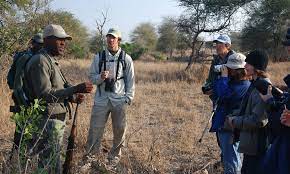
- It is a three-night trail with the two days in between spent walking.
- Trailists arrive and book in at the reception of the rest camp from where the trail departs.
- The trail ranger meets the group at 15h30 in a designated parking area in the respective rest camp.
- At this point trailists must be ready and equipped as well as all last minute shopping done before the trail departs which only comes back after the three nights in the wilderness camp.
- A maximum of eight persons between the ages of 12 and 65 years may participate per trail. To derive the optimum benefit and enjoyment from a trail adventure, it is recommended that a group comprises persons of a similar age, with common interests and the same level of fitness.
- A reasonable level of fitness is required as up to 20 km may be walked per day. The distance is covered at a leisurely pace, however, to afford trailists an intimate encounter with the wilderness. Due to the terrain covered and the safety factor, handicapped persons should not participate in these trails.
- All participants have to complete an indemnity form before embarking on a trail. Minors must be in possession of a form signed by a parent or legal guardian. These forms should be handed to the trail ranger before departing on the trail.
- The general rules and regulations of the Kruger National Park also apply to trailists.
- Trailists depend on the trail ranger for their safety and for guidance. The trail ranger should therefore be obeyed at all times. Failure to co-operate in this respect could lead to the immediate cancellation of the trail.
- For safety and ethical reasons liquor may be consumed at the trail camp only. Excessive consumption of liquor is strongly discouraged.
- Trailists provide their own liquor and soft drinks.
- Limited space is available in a communal refrigerator.
- Malaria Prophylactics are essential. Please consult your chemist.
- The trail camps are rustic and spartan. There are no electricity or power generators. Accommodation consists of A-frame huts or tents, as is the case at Napi camp. There are four units that sleep two each. Ablution facilities are communal except the Napi tents where it is en-suite. All linen and towels are provided.
- Ablutions consist of flush toilets and gas geyser showers.
- There is a communal social area (lapa) with thatched roof or open campfire area.
- Cooling facilities consists of a fridge with limited space.
- The cook prepares all meals in a very basic kitchen with washing up basins and storing facilities.
- A fence surrounds the camp but it is basically only to tell animals and people where the camp boundary is.
- Water for washing gets pumped from boreholes close to camp. Water should not be wasted unnecessarily – especially in dry times.