Wilderness trails- Napi Wilderness Trail
Kruger National Park- Activities
| Contact Details | |
|---|---|
| Telephone | +27 12 426 5111 |
| Website | www.sanparks.org |
| reservations@sanparks.org | |
| Physical | Pretoriuskop Camp Road, Kruger National Park |
Profile
This wilderness area is situated on the undulating granitic landscape between Pretoriuskop and Skukuza restcamps. Both the Mbyamithi and Napi rivers flow through the area and offers scenic walks along the riverbanks with stunning large trees.
Vegetation consists mainly of broad leave woodland and tamboti thickets. Large open sodic patches are pleasant to the eye and host unique plants such as the summer impala lily.
Seasonal pans in these areas allows for lots of big game sightings. Both white and black rhino are regularly seen wallowing in these pans.
The camp is fantastic for night sounds and amongst others giant eagle and barred owl give the night character. The Mbiyamithi river is one of the best habitats to view thick billed cuckoo because of the prevalence of it’s parasitic host the redbilled helmet shrike.
The camp consists out of four safari tents with on suite ablutions and a large veranda from which to view the surrounding bush and the Mbiyamithi river below the tents.
- Wilderness trails start on either a Wednesday afternoon to a Saturday morning or a Sunday afternoon to a Wednesday morning.
- It is a three-night trail with the two days in between spent walking.
- Trailists arrive and book in at the reception of the rest camp from where the trail departs.
- The trail ranger meets the group at 15h30 in a designated parking area in the respective rest camp.
- At this point trailists must be ready and equipped as well as all last minute shopping done before the trail departs which only comes back after the three nights in the wilderness camp.
- A maximum of eight persons between the ages of 12 and 65 years may participate per trail. To derive the optimum benefit and enjoyment from a trail adventure, it is recommended that a group comprises persons of a similar age, with common interests and the same level of fitness.
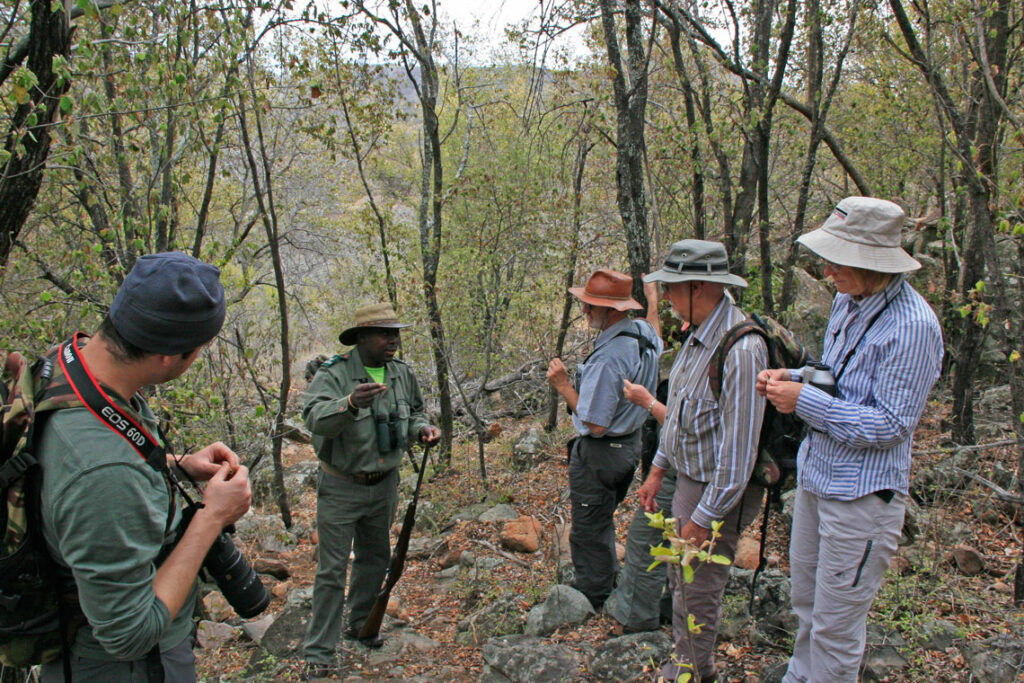
- A reasonable level of fitness is required as up to 20 km may be walked per day. The distance is covered at a leisurely pace, however, to afford trailists an intimate encounter with the wilderness. Due to the terrain covered and the safety factor, handicapped persons should not participate in these trails.
- All participants have to complete an indemnity form before embarking on a trail. Minors must be in possession of a form signed by a parent or legal guardian. These forms should be handed to the trail ranger before departing on the trail.
- The general rules and regulations of the Kruger National Park also apply to trailists.
- Trailists depend on the trail ranger for their safety and for guidance. The trail ranger should therefore be obeyed at all times. Failure to co-operate in this respect could lead to the immediate cancellation of the trail.
- For safety and ethical reasons liquor may be consumed at the trail camp only. Excessive consumption of liquor is strongly discouraged.
- Trailists provide their own liquor and soft drinks.
- Limited space is available in a communal refrigerator.
- Malaria Prophylactics are essential. Please consult your chemist.
- he trail camps are rustic and spartan. There are no electricity or power generators. Accommodation consists of A-frame huts or tents, as is the case at Napi camp. There are four units that sleep two each. Ablution facilities are communal except the Napi tents where it is en-suite. All linen and towels are provided.
- Ablutions consist of flush toilets and gas geyser showers.
- There is a communal social area (lapa) with thatched roof or open campfire area.
- Cooling facilities consists of a fridge with limited space.
- The cook prepares all meals in a very basic kitchen with washing up basins and storing facilities.
- A fence surrounds the camp but it is basically only to tell animals and people where the camp boundary is.
- Water for washing gets pumped from boreholes close to camp. Water should not be wasted unnecessarily – especially in dry times.