Business input on Supplementary Budget
BUSINESS INPUT TO THE NEDLAC EXECUTIVE COUNCIL MEETING ON THE SUPPLEMENTARY BUDGET: 26 JUNE 2020
Delivered by Martin Kingston, BUSA Vice President
- Introduction and Summary Messages
• Good morning Minister Mboweni, the team from National Treasury, Nedlac Executive Director, and leaders of the Nedlac social partners.
• While the focus of today’s engagement is on the fiscal situation confronting our nation, we must nonetheless keep at the forefront of our considerations the fact that we are confronting an unprecedented pandemic and our collective attention must first and foremost be about saving lives. In this regard, we broadly welcome and endorse the supplementary budget presented this week.
• Having said this, the necessary public health, social and fiscal interventions necessitated by the COVID-19 pandemic have worsened the already dire fiscal and economic situation facing us. While we accept the need to take on significantly more debt to finance urgent health, social and economic interventions, the need for equally urgent structural and policy reforms has been hastened. We are living on borrowed time and we collectively need to display as much energy and decisiveness in confronting our economic challenges as we have in confronting the current pandemic. - Economic Outlook
• Minister, according to the forecast presented in Wednesday’s speech, GDP is expected to fall by 7.2% in 2020 – a forecast, as we indicated last week, which is significantly below that of Business for South Africa, which forecasts a GDP decline of between 8% and 11% in 2020, recovering steadily in 2021 and 2022 with muted growth thereafter. The extent to which growth (both domestic and international) emerges on the downside
will obviously have significant implications for the fiscal outlook and it will serve us well to err on the side of caution in terms of spending plans going forward. Any recovery is fundamentally predicated on decisive and collaborative action now.
• By way of an example, Business indicated last week its forecast for a 13.3% budget deficit in the current fiscal year – considerably below the figure presented by Treasury this week of a consolidated budget deficit of R761.7 billion, or 15.7 per cent of GDP in the 2020/21 financial year. Without certainty as to how the COVID-19 pandemic will evolve, a variable is introduced into our economy and the budgeting process that defies simple planning. We will increasingly have to be ruthless in our quest for efficiency in public spending and economic decision-making.
• While the pandemic must absorb much of our focus, we cannot forget that our economy has been severely underperforming for several years owing to the structural constraints that we have been unwilling to confront. It is increasingly urgent that we comprehensively address the structural constraints that have been holding back growth for the last decade. Until we do this, we are unlikely to see meaningful and adequate growth. Regrettably, the shocking narrow unemployment rate of above 30% released this week is likely to increase yet further as the effects of the recent lockdown and still constrained levels of activity continue to filter through the economy. We need to return our economy to maximum levels of growth as quickly as possible, at all times with due consideration to health and safety protocols.
• Last week we highlighted some of the interventions required, which bear repeating:
o The envisaged reforms and interventions are well-known, and many have been articulated by National Treasury. These include:
o Tackling crime and corruption;
o Improving the ease of doing business;
o Mobilising large scale infrastructure projects profiled earlier this week at the SIDSSA;
o SOE reform and rationalisation;
o Clarity on land reform;
o Education and skills development;
o Reviewing trade policies;
o Labour market reform;
o Simplifying mining investment regulation;
o Aligning national energy strategy across all key plans; in that respect we need to question the timing of raising the profile of new nuclear and coal based projects;
o Rollout of broadband through partnerships with the private sector and finalising spectrum auction; and
o Financial inclusion and fiscal support where required.
• Many of these were articulated in government’s Towards an Economic Strategy for South Africa paper and we urge implementation thereof without delay.
• Moreover, greater visibility is required on fundamental structural reform long before the MTBPS is tabled, and we urge government to not only signal intent but also to expeditiously begin implementation. We stand ready to work alongside National Treasury in assisting in the assessment and implementation of the set of far reaching reforms referred to at the outset of this presentation. - Fiscal Policy
• Colleagues, our views on fiscal policy are well known and have been consistent for many years. In this respect, we welcome the general tone of the supplementary budget, particularly with respect to public sector wage restraint and SOEs. An unfortunate fact confronts us: the balance between discretionary and non-discretionary spending has been tilting inexorably towards the latter for several years and this trend must be reversed.
• We are encouraged by the statement in the Supplementary Budget Review that there must be broad-based reforms at state-owned companies so that they can become efficient and financially sustainable. We support the plans for these reforms to include rationalisation (reducing the number of and merging some state-owned companies, and incorporating certain functions into government), equity partnerships, and stronger policy certainty and implementation; and that transfers from the fiscus will be strictly conditional on improving their balance sheets. We caution however, that much of this has been promised before with little action.
• The introduction of zero-based budgeting is a key development in informing the 2021 MTEF, which should be endorsed by Nedlac. Justifying expenditure on the basis of need rather than want is the only way to ensure that spending is appropriately prioritised, and we applaud government’s adoption thereof.
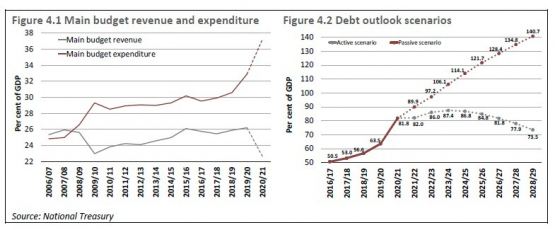
• We need to ensure that the plans set out in the MTBPS later this year to narrow the deficit so that debt peaks at 87.4 per cent of GDP by 2023/24 are rigidly adhered to and,
where possible, augmented. Failure to do so may very well lead to a full-blown debt crisis over the medium term.
• While the US$7bn in borrowings from International Financial Institutions are necessary at this time, we caution that foreign currency borrowings with a volatile exchange rate may render repayments equally volatile. One of the strengths of our public debt profile has been the fact that it is overwhelmingly Rand-denominated. As our borrowings increase, this balance will of necessity change and can only be remedied through systematically reducing our debt burden. - Revenue and tax policy
• The downward revision in gross tax revenue for the 2020/21 fiscal year from R1.43 trillion to R1.12 trillion – an unprecedented reduction in anticipated revenue of over R300bn – should leave none of us unaware of the gravity of the situation..
• While some of this is attributable to the much-needed tax relief measures contained in the Disaster Management Tax Relief Bill and the Disaster Management Tax Relief Administration Bill, the majority is attributable to the weak economy.
• We therefore cautiously welcome the fact that Treasury plans relatively modest tax increases of R40 billion over the next 4 years, bearing in mind that this follows five years of very significant tax increases. We urge that these increases – to be announced in the 2021 Budget – strike an appropriate balance between revenue needs and economic growth.
• In business’s view, further tax increases over the medium term could do more harm than good and will only serve to stifle economic activity. As the economy recovers, and as businesses grow and employment picks up, tax receipts will correspondingly increase. We therefore need to focus our energies on growth, and tax administration to make tax payments as seamless as possible and reduce the debt to GDP ratio.
• We therefore welcome the focus by SARS on international taxes (particularly aggressive tax planning using transfer pricing), increasing enforcement to eliminate syndicated fraud related to VAT refunds and import valuations, expanding the use of third-party data to find non-compliant taxpayers, and improving the collection of debt due to the fiscus, and ensuring that outstanding taxpayer returns are filed and liabilities paid. - Conclusion
• Minister and social partners, the take home message from today’s engagement must be one of urgent implementation. Under difficult circumstances, Treasury has presented a credible supplementary budget that seeks to cater for the needs of our people while steering us away from an impending fiscal precipice. We need to pull together and support Treasury’s efforts.
• Informing these efforts must be an overriding focus on economic growth. Without this, confidence will continue to collapse, and investment will not be forthcoming. We know what needs to be done, and notwithstanding the short-term difficulties, the path ahead is one of prosperity and inclusivity. That potential can only be achieved if we act collaboratively, in solidarity and immediately. The potential upside can only be achieved by ruthless curtailment of unnecessary expenditure, unstinting promotion of significant investment, aggressive collection of taxes and associated transparency and accountability to rebuild trust.
• We therefore propose – as a specific call for a Nedlac process – an engagement at the highest levels in the near future on an accelerated Economic Recovery Strategy as an input for action on the reform agenda, inclusive of an indicative timetable of the proposed engagements to monitor the required reforms, with specific focus areas and a commitment to regular public updates to restore business and stakeholder confidence.
• The Minister has consistently advised us of the need to close the jaws of the hippo. We currently stand between the hippo and the water. We can only close those jaws if we act in unison, with agility and with purpose.
The budget in seven charts
They’re not pretty pictures.
Larry Claasen 25 Jun 2020 00:02
The unusualness of Finance Minister Tito Mboweni’s second budget of the year can be seen in him delivering his speech from a government briefing room in Pretoria, and not from a parliamentary chamber in Cape Town where he would be playing to the crowd.
This time there wasn’t just no crowd to play to, standing in front of a podium with white panelling at his back gave the impression he was speaking under duress from some undisclosed bunker.
Judging from the dire position of the country’s finances as a result of the global Covid-19 crisis, a bunker would almost be an ideal place to give his speech.
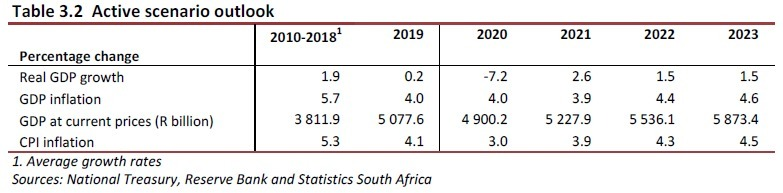
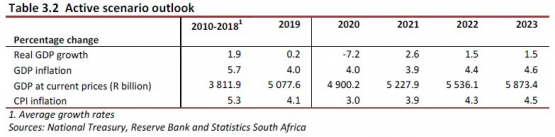
“The South African economy is now expected to contract by 7.2% in 2020,” he said. “This is the largest contraction in nearly 90 years.”
Source: National Treasury, Reserve Bank, Statistics SA
The outlook for the next three is not expected to get any better either: GDP is forecast not to breach 3% for this period.
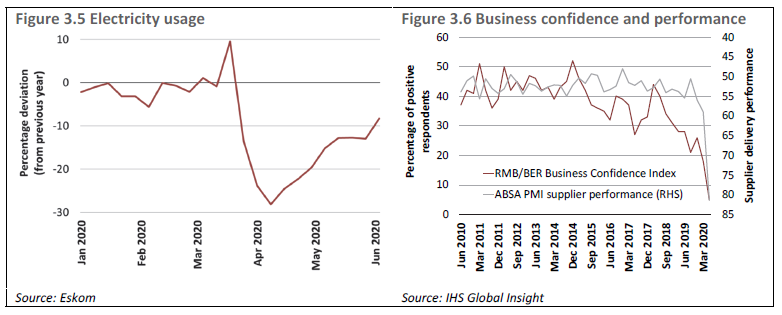
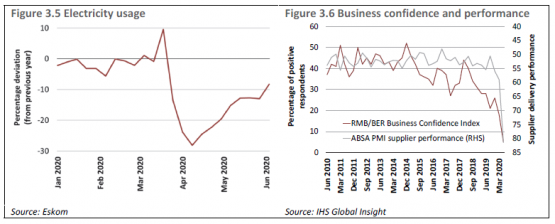
Already, the economic slowdown can be seen in sharp falls in electricity usage – down 30% year-on-year in April – and business confidence near historic lows.
Sources: Eskom and IHS Global Insight
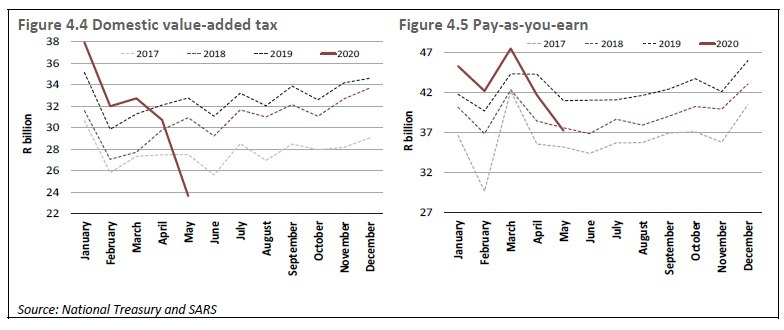
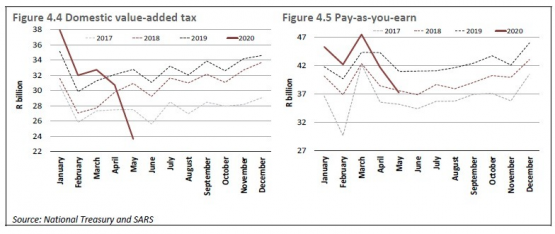
The weak economy has already knocked tax revenue, resulting in Treasury expecting to miss its tax target for this year by over R300 billion.
Source: National Treasury, Sars
The scale of the falloff in tax collection, as well as the rise in unemployment and wage cuts, can be seen in pay-as-you-earn (PAYE) tax revenue falling from R47 billion in March to about R37 billion in May.
There is a similar story with Vat, which fell from R38 billion in January to just under R24 billion in May.
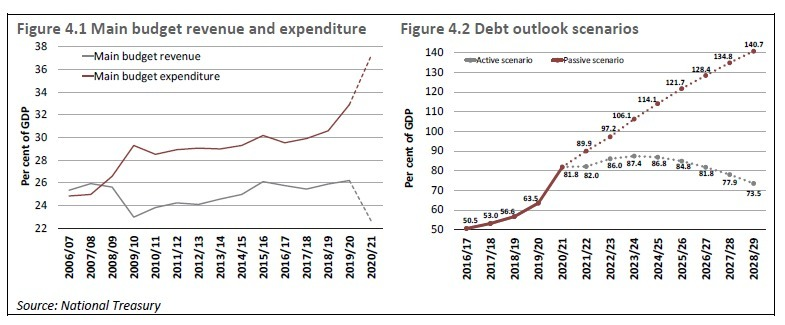
The sharp decline in tax collection will see public debt as a percentage of GDP hit 81% for the 2020/21 period. If not actively managed, this debt could reach 97.2% in 2022/23.
Source: National Treasury
Not all of the R300 billion tax shortfall is a result of a reduction in collections.
“Part of this revision is because the measures announced earlier this year give taxpayers outright relief of R26 billion and delays in tax collection of approximately R44 billion,” said Mboweni.
As bad as things are, Mboweni warned that they could actually get worse.
Like in February, he once again said that if SA does not get its debt under control, it is on the path to ending up having a sovereign debt crisis like pre-World War II Germany or more recently, Argentina and Greece.
Impact
“The wide gate opens to a path of bankruptcy. A sovereign debt crisis is when a country can no longer pay back the interest or principal on its borrowings. We are still some way from that. But if we do not act now, we will shortly get there.”
This could result in interest rates and inflation skyrocketing, see a drop in spending, and affect the country in severe and even peculiar ways.
“Argentina had its ships attached. Greek civil servants and pensioners had their salaries and pensions slashed.”
He cautioned in a media briefing after the speech that there is no easy way around the difficulties SA has to face and that not even the $7 billion (about R121.5 billion) loans from the likes of the International Monetary Fund (IMF) and the World Bank will solve its problems.
Firstly, it still hasn’t gotten the funding.
So far, the Brics-backed New Development Bank has provided a $1 billion loan. Getting the buy-in from the IMF has not been so easy. Mboweni says the negotiations for a $4.2 billion loan have been “protracted”, “tough” and “difficult”. While an agreement was reached in principle, the IMF’s executive board still needs to approve it.
He expects the World Bank and the African Development Bank to provide funding.
But even if it gets funding, this will not solve SA’s issues because they are loans, which ultimately means they have to be paid back.
Jean Dommisse
PhD Candidate
Head: Client and Market Insights
SPF: Client Experience
2 Strand Street, Bellville, 7530 | PO Box 1, Sanlamhof, 7532