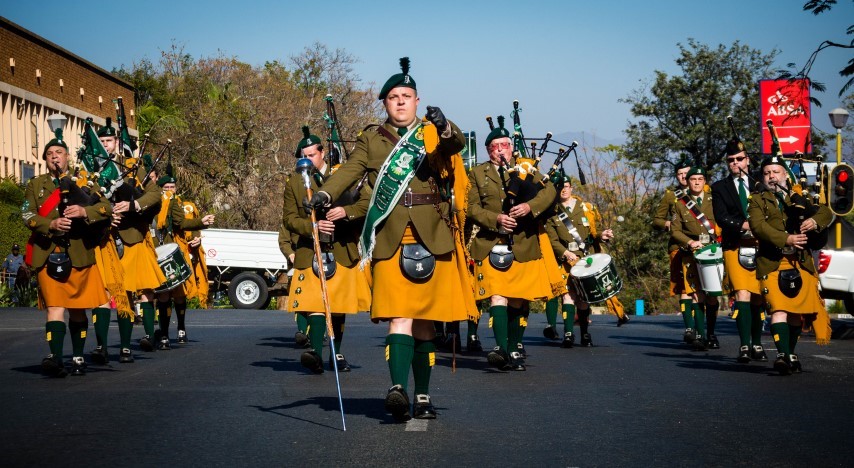
Annual Freedom of the Town Parade – Barberton, 31 August 2019
At 09h00, on SATURDAY, 31 AUGUST, the streets of Barberton will once again be filled with the thrilling sounds of the Pipes and Drums of the SA Irish Regiment as they march from the MUSEUM – and along CROWN STREET to the Cenotaph – to take part in the spectacular annual Freedom of the Town Parade at 10h00 wherethey will be joined by Regiment Botha, the Wits Rifles and the Transvaal Scottish Regiments. These regiments were all based in Barberton at various stages during World War II and granted Freedom of the Town many years ago. A military band of the South African army will lead the Parade and veterans from the local MOTHS will also be in attendance.
Barberton is the only town in the Lowveld where this happens, it only happens once a year and everyone is invited to support these units as they march through town.
16h30 for 17h00 : SUNSET PARADE, Garden of Remembrance, Henry Nettman Street
The moving Sunset Parade will comprise a short commemoration service, Last Post and a Drumhead Service.
Freedom of the city is an honour granted to martial organizations, allowing them the privilege to march into the city “with drums beating, colours flying, and bayonets fixed”.
It dates back to ancient Rome which regarded the pomerium, the religious boundary of the city, as sacred. Promagistrates and generals were forbidden from entering it, and resigned their imperium (power to command armies) immediately upon crossing it.
An exception was made for victory celebrations (called triumphs), during which the victorious general would be permitted to enter for one day only.
Under the republic, soldiers also lost their status when entering, becoming citizens. Thus soldiers at their general’s triumph wore civilian dress.
Weapons were also banned inside the pomerium for religious and traditional reasons.
The awarding of the freedom is often accompanied by a celebratory parade through the city.
Similar laws were passed by other European cities throughout the medieval era, to protect public security and civic rights, even against their own king’s troops.
As a result, soldiers would be forced to camp outside the walls of the city during the winter months.
The freedom of the city was an honour granted only to troops which had earned the trust of the local populace, either through some valiant action or simply by being a familiar presence.
In the modern era of today, martial freedom of the city is an entirely ceremonial honour, bestowed upon a unit with historic ties to the area, as a token of appreciation for their long and dedicated service.