

Scientific Drilling Project in the Barberton-Makhonjwa Mountains
Drilling for Answers
to the Early History of our Planet
in the Barberton Makhonjwa Mountains World Heritage Site (BMM WHS)
SUMMARY: This Scientific Drilling Project has nothing to do with searching for valuable minerals and resources. It intends to expand our knowledge of the early earth and the beginnings of life, as recorded by our most ancient rocks. This project will provide the basis for scientific exhibitions to support tourism, visitor awareness and education locally, nationally and internationally.
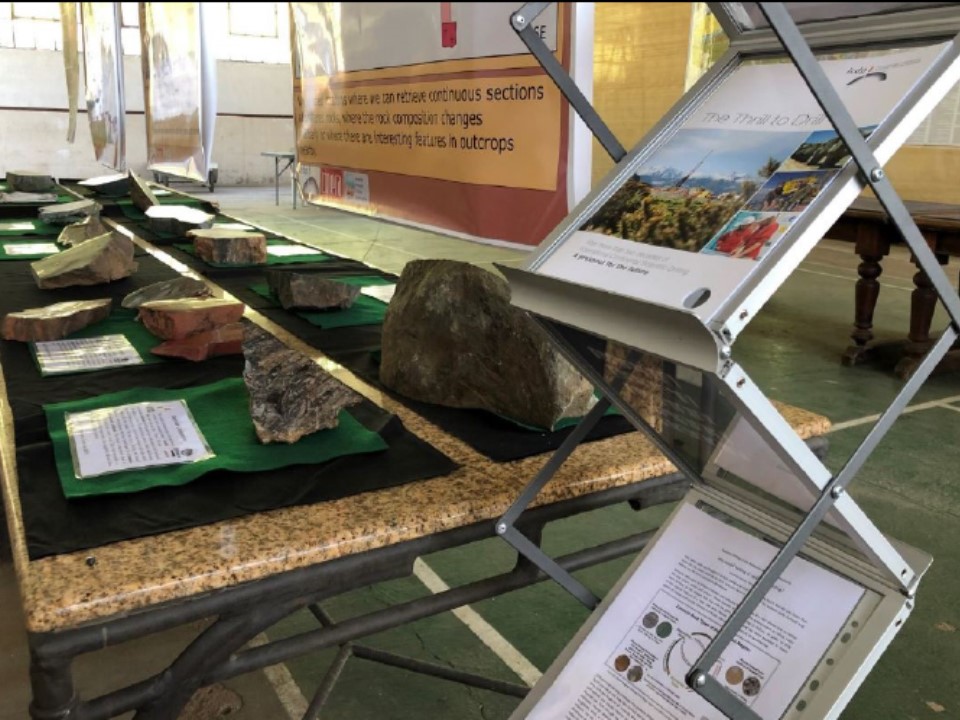
The Moodies-BASE Drilling Project is a fitting event to mark international recognition of the value of the Barberton-Makhonjwa Mountains, which, in July 2018, were proclaimed a UNESCO World Heritage Site (BMM WHS). This drilling project has been carefully planned for over five years, by dozens of acclaimed geologists from many countries, led by Prof. Christoph Heubeck from Jena University in Germany. The project started in late November 2021, encountering some technical and wet-weather delays before the Christmas break. Fortunately, the project is now fully operational with two drill rigs producing underground rock samples that are being recorded and temporarily stored in the Barberton Iron And Steel (BIAS) hall of the Barberton Museum. Visitors to the BIAS hall will have access to a geology exhibition that includes rock specimens, geological maps, drill bits and a work space that showcases how freshly-drilled rock samples are marked, cut, photographed, described and stored.
(‘Moodies’ – the youngest of the three ancient rock sequences of the Barberton region; BASE –
Barberton Archaean Surface Environments.)
Over the next four months about 4km of drill-core is expected from eight
holes, providing fresh rock samples
to research labs in over a dozen countries. The project will ultimately produce
a series of research papers over the
next few years. These will help explain our planet’s earliest history, the origins
of life on Earth and, by extension, on other planets
too. Our WHS is the preferred global
location to search for these answers and is one of the main reasons for it being proclaimed a World Heritage Site by UNESCO.
The purpose of our WHS includes:
- protecting its geological assets (geoheritage) for their high scientific value;
- using these assets and their valued status to attract researchers and visitors from around the world to promote further research and educational tourism;
- informing visitors in ways that are enjoyable and educational, and to benefit local communities by way of sustainable jobs in tourism.
Carefully planned research is essential to this WHS’s existence; it enhances our knowledge of our planet and expands the Outstanding Universal Values of our WHS. This is why the Moodies-BASE Drilling Project has the support of all the relevant authorities and of the landowners where each of the drill holes is located.
This project will significantly expand our knowledge of events recorded in our uniquely ancient rocks. It will also provide, in Barberton Museum’s BIAS building, the basis for a permanent physical display of ‘big science in action’ that will create awareness locally and internationally.
The public is encouraged to visit the BIAS hall of the Barberton Museum in order to learn more about the geology of the Barberton region and the concept of drilling for scientific knowledge instead of underground economic resources. Visits to drill sites may be organized by sending an email to moodiesbaseproject@gmail.com. For project updates, please like and follow the facebook page ‘Moodies-BASE Project’ where a link to daily project updates has been posted.


