

Research Geologists return to Barberton Makhonjwa Mountains
It has been more than a year since international geoscientists have walked the slopes of the Barberton Makhonjwa mountains. Their Covid- enforced absence has been well-spent. They are planning a come-back of high significance that will boost geological research in the area and a better understanding of the early history of our planet.
The geoscientists have proposed and received funding for a scientific drilling project under the auspices of the International Continental Drilling Programme (ICDP), a 20-country global consortium to support geological research.
The drilling project has been in planning for five years, involving over 50 researchers from about 15 countries; it is led by Prof. Christoph Heubeck of Jena University in Germany, well known from his numerous field seasons in Barberton. Co-leader of the drilling project is Prof. Nic Beukes from the University of Johannesburg who has had extensive experience in managing scientific drilling in southern Africa and the oldest rock record of our planet. These two colleagues were recently in Barberton to inspect all proposed drill sites, together with relevant land-owners and stakeholders, to file necessary permits and to prepare for the smooth operation of the programme which will be conducted over a period of 5 to 7 months later this year.
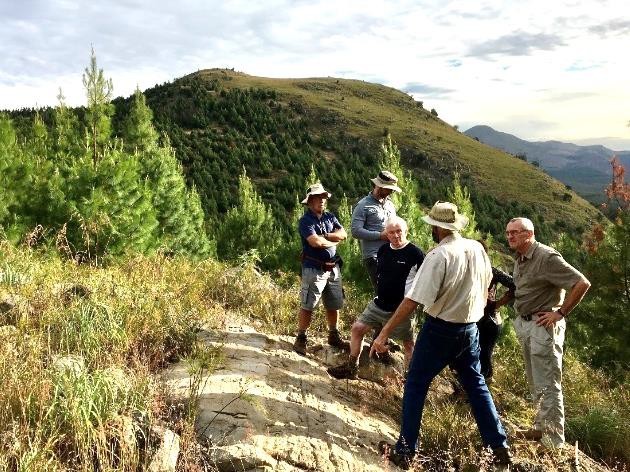
Members of the Research Drilling group (from left to right Nic Beukes, Bertus Smith, Rodney Tucker, Tony Ferrar, and Johan Eksteen) inspecting a rock outcrop to discuss expected results. The hill in the background will be probed by a 450m-long borehole.
The drilling will transect the immensely old (3.22 billion years) sedimentary rocks of the Barberton Greenstone Belt, the so-called Moodies Group, along the northern margin of the Barberton Makhonjwa mountains. These sediments were laid down in coastal plains, estuaries and sandy beaches of the early earth. The rocks also show
that early microbial life was already well established in the hot
oceans and extensive biomats along the shorelines. The research team looks very much forward
to the start of the drilling campaign.
They expect results of the
research to shed light on the processes that allowed early life to colonize the current-
and wave-dominated, high-energy
coastlines.
The drill holes will produce cores, about 5 cm in diameter and up to 500 m in length, from each of eight planned holes. These cores will be carefully described and investigated geochemically. Half will be permanently stored at the National Repository of drill cores near Pretoria while the other will be curated at the core storage facility of ICDP in Potsdam (Germany). Because this will be a purely scientific drilling project, all information will eventually be made public. The drilling project would thus be complemented by a substantial Education and Outreach Programme (EOP) program before, during and after the drilling. These activities will educate the public about scientific investigations in Geosciences (‘Drilling for Knowledge’) to create curiosity for and an appreciation of nature and Earth history. The programme will also advertise the wider values of the Barberton Makhonjwa Mountains World Heritage Site, including its value as a tourist attraction.
For further information, contact: Prof. Christoph Heubeck, Christoph.heubeck@uni-jena.de or Prof. Nic Beukes, nbeukes@uj.ac.za


